HUMAN GREED is the ARCHITECT of EARTH CRISIS!
No one is safe anymore! No one will be safe in the near future!
Apocalypse NOW has become the current “State of Earth”!!!
YES, the global leaders or should the right term “Dictators of Democracy” be used to describe these hostis humani generis of the Millennia – who are busy waging unwanted GENOCIDE in GAZA, WEST BANK, SUDAN, LEBANON and YEMEN and war in Iran, Ukraine, Russia, Ethiopia, Saudi Arabia, UAE, Bahrain, Qatar, Kuwait and Oman — to satisfy their egos and human greed.
As if deadly and destructive WARS are not sufficient – now these “Dictators of Democracy and Humanity” have all waged war against their own citizens and TEENS – France, Germany, Netherlands, Belgium, India, Spain, Madagascar, Nepal, Kenya, Greece, Indonesia, Philippines, Peru, Ecuador and Bolivia.
Hypocritically, the global leaders have billions and trillions of dollars to destroy other nations, but no money for EDUCATION to strengthen their respective nations. However, the GEN Zs of all the above nations have taken up seriously their “Duty and Responsibilities” to demand for their “Rights” and the “Realm of Prosperity and Calm”.
‘zerobeyond – the new frontier!’ has been at the forefront to groom-to-mentor the GEN Zs since the past half a decade, so that GEN Zs can build a better future for them as well as the next generation. We strongly believe:
“GEN Zs has the difficultas immanis to mitigate the predatory elites’ never-ending greed and build their future world based on surviving apocalypse with empathy and sensibilities.”
The Future I Aspire for today’s GEN Zs and thereafter…..
9th October 2026 – 7.7 Magnitude Earthquake in PANAMA struck the southern coast of Panama causing widespread damage, structural collapses, and nationwide disruptions. It had triggered more than 100 aftershocks—the largest reaching a magnitude of 6.6—and prompted temporary tsunami warnings across several Pacific coastlines.
8th October 2026 – Apocalypse in CHILE! Mudslide Devastates San Carlos de Apoquindo in Las Condes.
THAILAND’s Capital city Bangkok and all its districts’ apocalyptic flooding have shaken the world, but not the policymakers.
Vietnam, India, Syria, Philippines, Thailand and Nepal again for the second time have been doomed in the Asian continent.
Ecuador, Chile, Brazil, Colombia and Paraguay – all the Southern American nations have experienced devastating human greed catastrophes in the first ten days of October 2026.
Alabama, Georgia, South Carolina, California, Omaha – Nebraska, Texas and Florida have been flooded drastically. Mexico also experienced devastating flooding. Wildfires in Los Angeles, California have already burned more than 1,200 acres within the first ten days of October 2026.
Turkey, Greece, Spain, Albania, Montenegro, Italy and France have all been flooded in one or the other regions with devastating effects in the European continent.
Senegal, Morocco, Nigeria and South Sudan have experienced catastrophic flooding in the African continent.
Australia, Fiji and Tuvalu also flooded in the Oceania continent. Papua New Guinea is currently experiencing severe drought, having experienced flooding in September 2026.
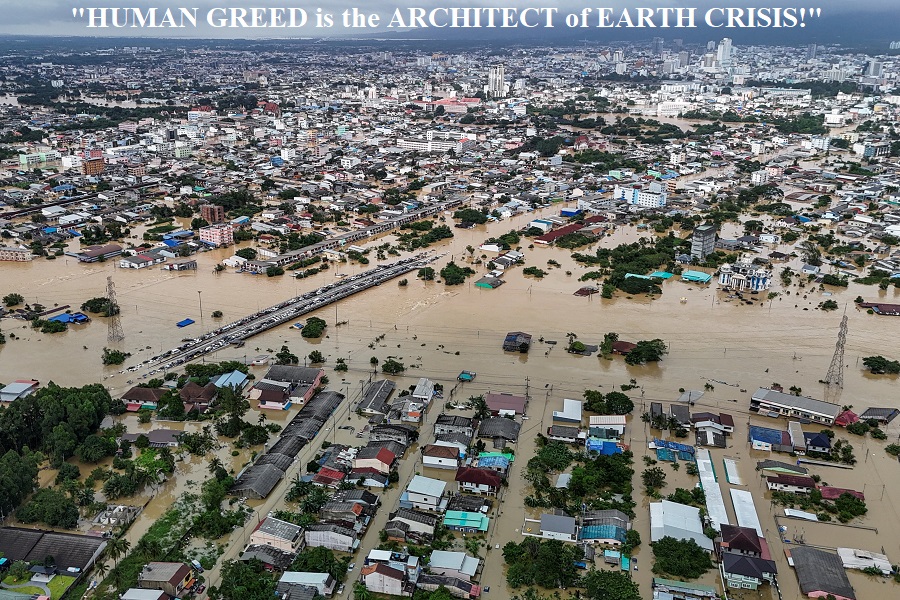
THAILAND – The Image has been used for Representation Purpose only
Whenever I interview an individual for the GEN Z Series, I make it a point to get their views about Earth Crisis. The below question opens up more options and issues to understand the subject. The exploration also shows how the younger generation of professionals are equipping themselves to understand this complex issue and how each one of them are gearing up with amazing perspectives and possible solutions.
Cities are getting inundated in a massive proportion due to flawed drainage and sewage systems apart from Climate Crisis. I wonder when urban planners and architects will be able to find a solid solution to overcome this herculean challenge to make cities flood proof – Your views.
“I believe that architects, urban designers, urban planners and the government should work together to find a solution to the flooding crisis. Together they can identify the main causes of the flooding and work towards eliminating them. Solutions include improving existing drainage and sewage systems, planting trees to increase the local water absorption rate, and developing sustainable water management techniques.
These techniques should take into account developments such as climate change, urban sprawl and ever increasing population density. The government should provide adequate funding to ensure these solutions are put in place properly. With the collective efforts of these groups, cities can become more flood-resistant and resilient. In my opinion, even if one of them is lacking, there might not be proficiently functioning cities.” – SIRI CHANDANA VENUGOPAL, Environmental Planner – Resource Consents @ Taranaki Regional Council, Taranaki – NEW ZEALAND

Click to Read: https://zerobeyond.com/lacuna-architecture-for-urban-rewilding/
Cities are getting inundated in a massive proportion due to flawed drainage and sewage systems apart from Climate Crisis. What are your views about flawed urban planning and remedies to rectify to make cities flood-proof?
“Jakarta, the capital city of Indonesia, is the world’s most rapidly sinking city. It is estimated to be submerged by 2050. The main reason is because the city is covered with concrete. Even millions of inhabitants use deep pumps to extract the water stored in aquifers’ layer. The more water is extracted, the more it deflates, causing the soil to compact and collapse, and the ground above to sink further. The rainfall that would naturally fill up the aquifers is not being absorbed because of concretization.
Dutch colonialism took a toll on the city’s flawed urban planning by making Jakarta feel like a Dutch city with narrow townhouses along a grid of canals using concrete to channelise rivers and use dykes to protect the city from being flooded. Those grey infrastructures are actually killers of the natural system.
Click to Read: https://zerobeyond.com/anahata-resort-bali/
Cities must be transformed into Sponge Cities. The basic idea is to allow the natural water flow to come back by maximizing green spaces and using permeable materials for hardscape. City should remove the flood wall, retreat dykes and create eco-friendly terraces, where land and water meet, depending on different levels of flood. So during the monsoon season, it is for the flood and on the other hand, during the dry season it becomes a park for everyday use.” – EUGENIA THEOVILIADEA, M. Arch NOV 2025, UNPAR – Universitas Katolik Parahyangan, Bandung – INDONESIA

Click to Read: https://zerobeyond.com/center-for-artificial-intelligence-ukraine/
“It is very ambiguous to choose one way to solve the problem. I believe that it is necessary to approach the question according to the context. If this is a city with highly developed engineering systems, it may be easier to solve there due to the modality of flexibility and the use of technology. If we talk about less developed locations, it would be wise to approach the issue comprehensively and change the entire system.” – ANASTASIIA KONOTOPENKO, Architect @ Peker & Partners, Kyiv – UKRAINE

Click to Read: https://zerobeyond.com/revitalisation-of-historic-meerut-city/
“In my opinion, the major problem in case of flawed drainage in urban cities is lack of policies. However, one cannot blame policy makers alone. This is not a one man’s job. To make the city sustainable and livable, we should adopt a holistic and inclusive approach. The day we will understand that this field is multidisciplinary, we will be able to overcome the challenges together.”– SOUMYA SINGH CHAUDHARY @ M. Arch 2021, School of Planning and Architecture, Bhopal, Madhya Pradesh – INDIA
“In my opinion, any strategy in architecture will take time to get fully implemented to get the required results. Nevertheless, I am a huge believer in the quote ‘prevention is better than cure’. Through my limited research, I believe potential solutions such as sustainable drainage, such as Susdrain can be implemented further. However, understanding issues at a macro-level cannot be resolved by just architecture. Architecture can be an aspect of the solution. Other fundamental elements, such as the economy – a country’s GDP and politics would definitely play a vital role.
Click to Read: https://zerobeyond.com/mindful-mental-health-prevention-centre/
For instance, a country such as Bangladesh (my country of heritage) which is prone to flooding at a greater level may find it difficult to implement sustainable drainage solutions in comparison to more developed countries. Despite this, I do think it is vital for architects, urban planners and designers to play their significant parts as much as possible to at least reduce the risk of floods.” – FARIHA AREFIN, Architect @ Muse Architects UK, Manchester – ENGLAND
Image Courtesy: Respective Architects