Like Father, Like Son
Taking his innovative stride with confidence, Hongjin YU, son of legendary Chinese Landscape Architect (Late) Dr. Kongjian YU, is taking his father’s legacy to a whole new level – that will benefit landscape architecture across the globe.
Resplendence
Transitioning the Oxymoron
Tony, as he is popularly and fondly known, is not only honoring his father’s philosophy and legacy of the radical “Sponge City” and “Big Foot Aesthetics”, but also is strengthening by continuing to challenge the global design status quo as an “Art of Survival”.
The 37-year-young CEO of Turenscape is taking his father’s ideas further. While his late father challenged ornamental gardening by calling the profession an “oxymoron”, Tony believes the next phase of regenerative design demands something deeper—making human intent invisible, so natural systems can survive. He sees this shift as the key to addressing Earth’s Crisis.
Turenscape under Tony’s new leadership has embarked into an innovative phase, thereby rewriting a new era by blending “AI – Artificial Intelligence” and “Ecological Wisdom” to shape the future of climate-resilient cities and landscapes. Tony has envisioned a “Sponge Planet” that will reshape landscape architecture in true sense to wipe out the age-old “Oxymoron” profession.

Illuminating among Stars – HAMI PTEROSAUR MUSEUM
Forging a Path Forward
Interestingly, Tony’s outstanding background may surprise many in the field of landscape architecture. He is currently pursuing his Ph. D in Computer Science from Southern Methodist University, Texas, USA. His background spans across Robotics, Computer Vision and Machine Learning.
Tony is developing intelligent tools for rapid design iteration, ecological simulation, participatory planning, and climate-adaptive decision-making. His vision is to make ‘Sponge City’ and ‘Sponge Planet’ design accessible to all, enabling citizens, designers, students, and governments to collaboratively build water-adaptive, nature-based urban landscapes through AI-driven platforms. He is pioneering the use of AI in landscape architecture that will benefit one and all across the globe.
Inheriting the stature of a legendary legacy is no small feat; yet, the way Tony navigates the responsibilities as the CEO of Turenscape to forge a path forward is truly magnetic. He continues to lead his outstanding team in its global mission to restore degraded ecosystems, revive water cycles, and advance nature-based solutions as core strategies for climate adaptation. His work focuses on uniting technology with ecological planning to help cities around the world build resilient, regenerative futures.
Breaking Norms
Johnny D explores the legacy and lessons of a legendary father in a wonderful interaction with Turenscape’s young CEO, Hongjin Yu. Together, they dive into Yu’s visionary mission to better the world by erasing the ‘oxymoron’ of traditional design—choosing instead to respect and collaborate with nature, rather than resisting it
What was your childhood ambition? Has your father influenced your childhood ambition?
I have always loved making robots and playing around with computers. This was from a very young age, and that love never faltered (smiles). It was my father’s hope that I would continue down the path that he took, but he also believed that people are like seeds. Each person will thrive in a different environment, so he never forced me to follow his footsteps.
Living Infrastructure
What is the most important lesson you have learned from your father – the legendary Landscape Architect? How has the lesson changed your life?
The most important lesson I have learned from my father was not from his lectures or teachings, but through observing his work. There is a natural flow of things – be the environment, nature, water, society, family relations or humans. There is a certain contradiction in his work – the profession Landscape Architecture is an oxymoron.
Landscape is not just about how greenery or a park looks like, but about how the natural elements function, and the relationship between nature and man. This requires one to let go, to give up control and to follow the natural rhythms.
Architects, however, want full control. To design something is to have a clear vision, and to realize that vision in its totality in the world. Harmony and clarity, there is no simple algorithm to achieve both, but you can find both in all his works. This requires wisdom, and is something that I am still learning.
Site Plan
You are currently pursuing Computer Science at Southern Methodist University as a Doctoral Candidate. Briefly elucidate your Doctoral Thesis.
My research is in improving LLMs – Large Language Models – a type of artificial intelligence designed to process, understand, and generate human-like text. Specifically the problems of hallucination, memory and new skill acquisition. I don’t think that we are that far from achieving AGI – Artificial General Intelligence. Machine learning has overcome most of the problems that we in the field once thought were ‘hard’ for computers. For example, determining if a picture is of a cat or a dog?
I would say that AI can already complete all System 1 tasks (e.g. 1+1=2, see “Thinking, Fast and Slow”) at superhuman levels. However they lack the ability to robustly complete System 2 tasks (e.g. 42*36=?). My goal is add System 2 capabilities to current AI models.

Perspective – HAMI PTEROSAUR MUSEUM
You are pioneering the use of AI in Landscape Architecture to benefit one and all, across the world. Briefly explain your vision.
With the advent of smart phone and search engines, we now not only have just a library in our pockets, but also a personal librarian that flips the book to the exact page you want. With AI, we will have every profession in our pockets, which includes Landscape Architects and designers.
From decision makers to citizens, we will have the ability to take out our phones, and it will be as if a real professional Landscape Architect was right there. They can give advice from a strategic planning point of view. For example, how should zoning be done to optimize biodiversity, minimize flood damage, and increase human happiness through interactions with nature? They can give personalized advice for home improvement. For example, how can I modify my rooftop to utilize rainwater and save money? AI will empower us to make more informed decisions.
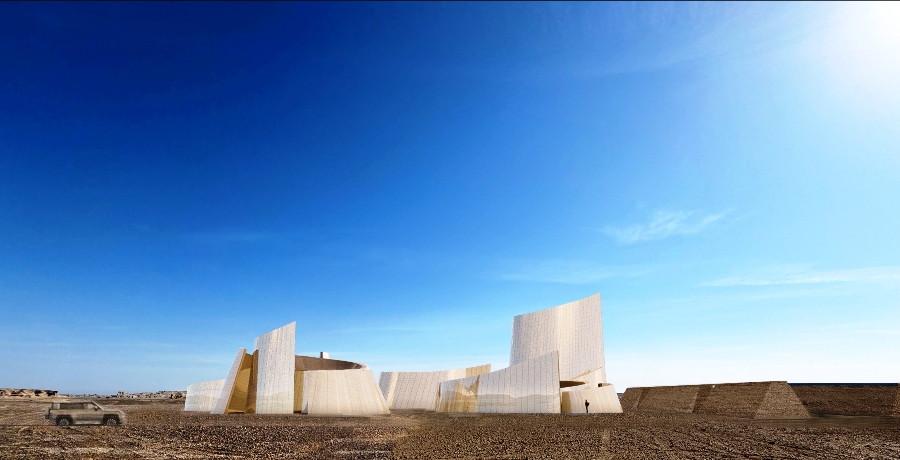
Daytime Elevation
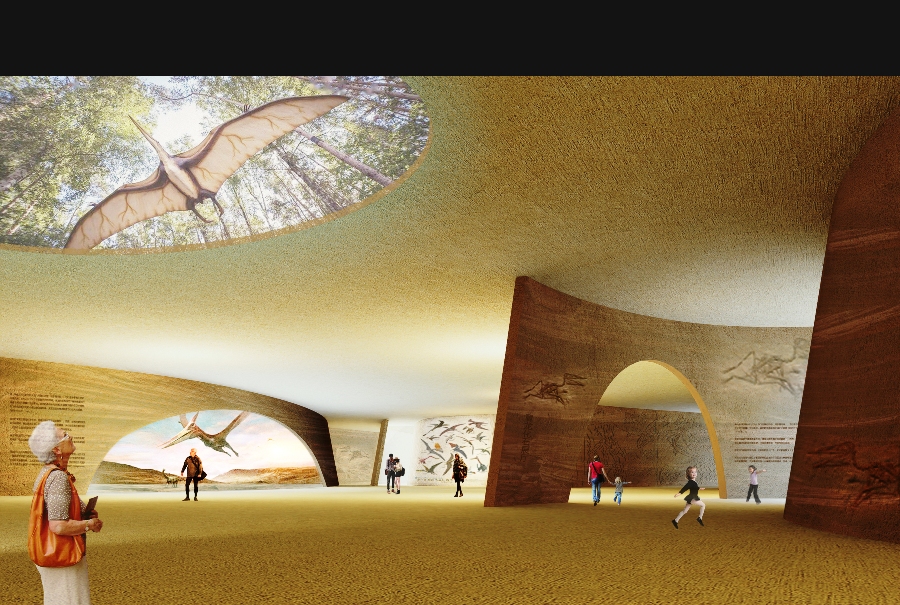
Turenscape is currently working on Hami Pterosaur Museum: Eco-Adaptive Design in Extreme Conditions. Briefly elucidate the project’s magnitude and challenges as the CEO of Turenscape.
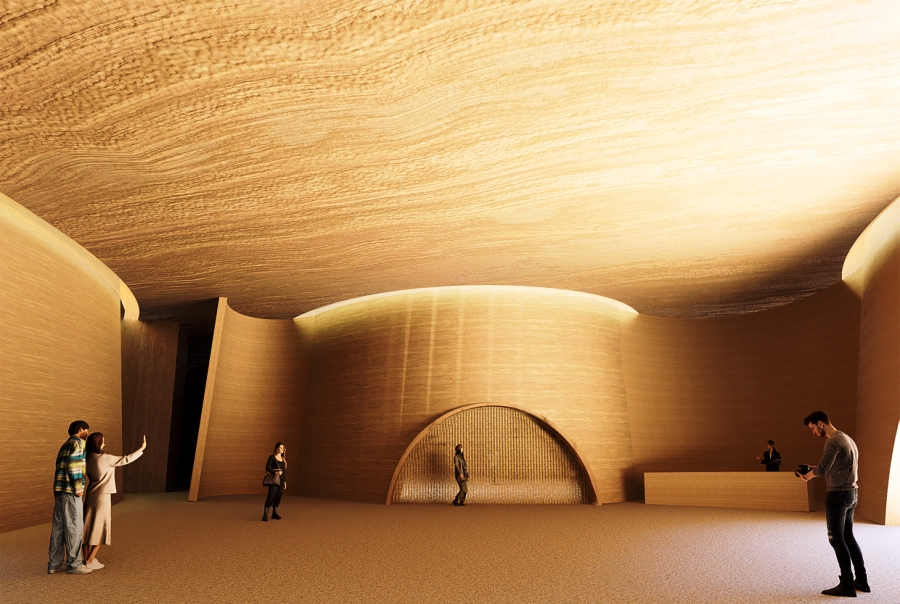
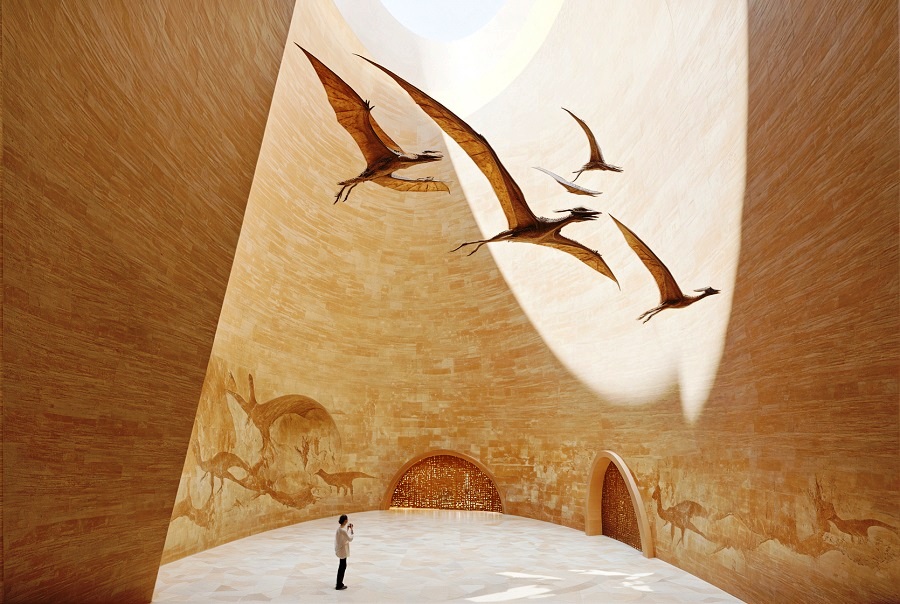
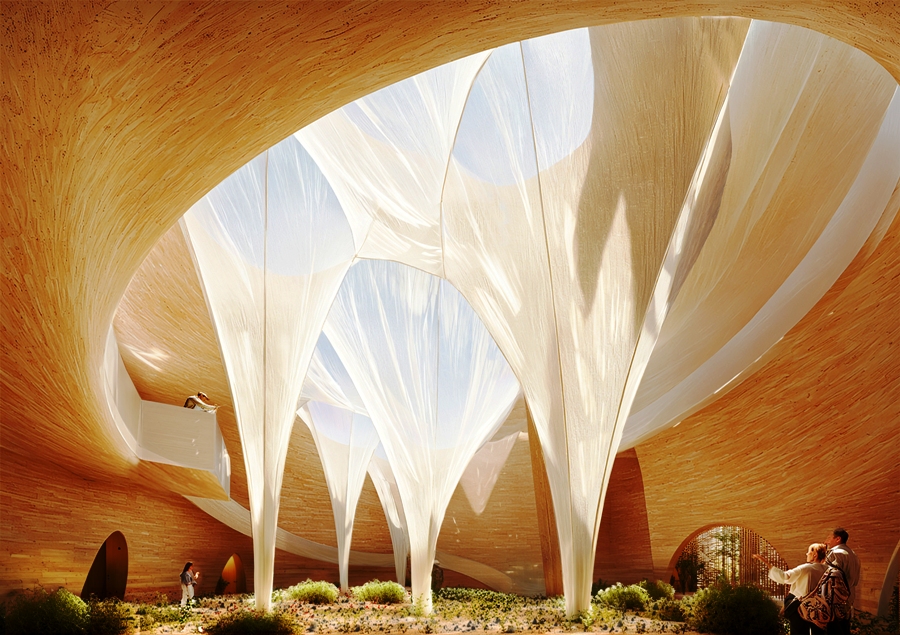
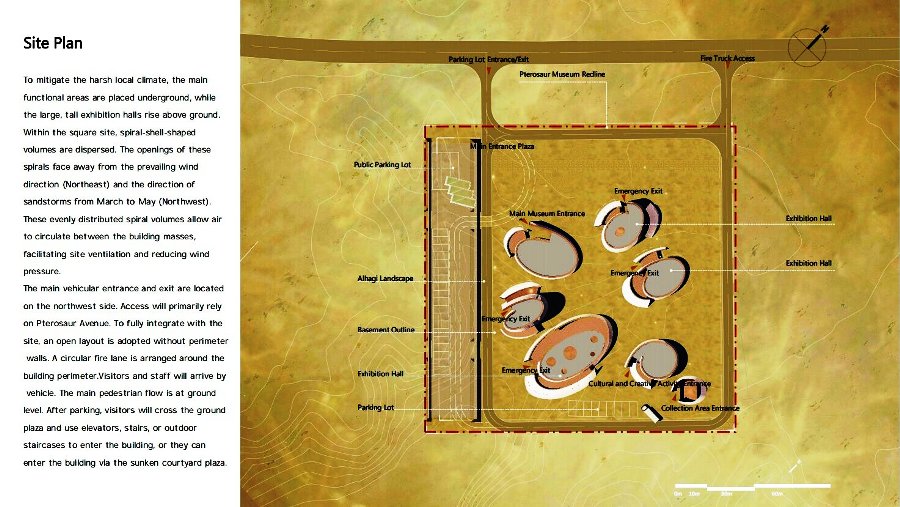
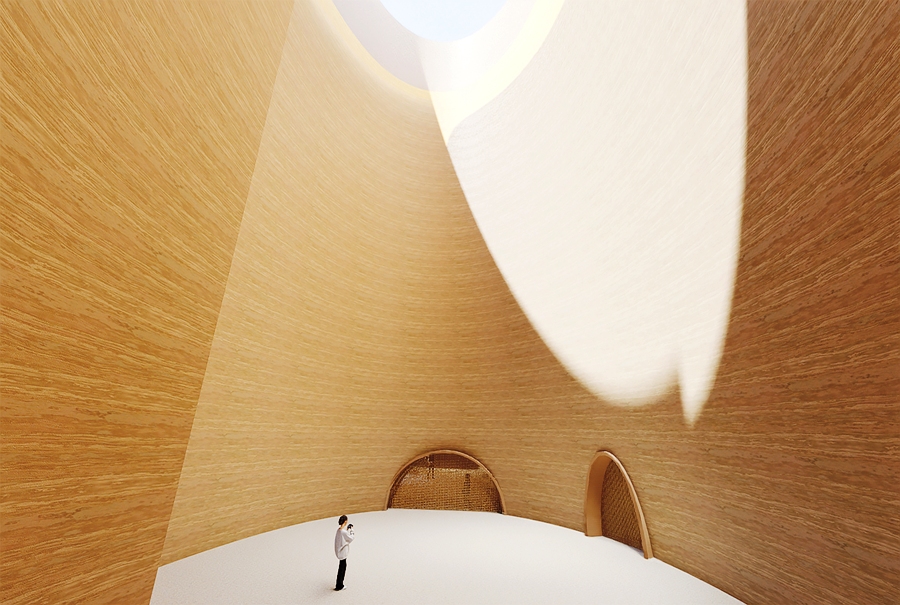
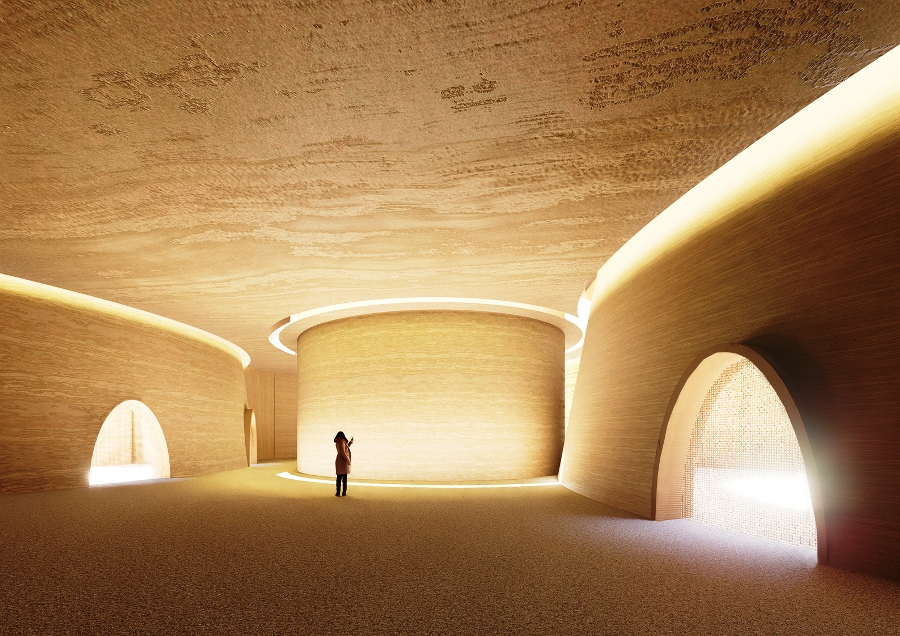
The Hami Pterosaur Museum is a highly challenging project located in one of the world’s harshest desert environments. With extreme aridity, violent sandstorms, large temperature swings, and intense solar radiation, the key challenge was to turn environmental extremes into design drivers. Through underground spaces, wind-adaptive forms, passive cooling, renewable energy, and closed-loop water systems, the project demonstrates a resilient, low-carbon model for cultural architecture in arid regions.
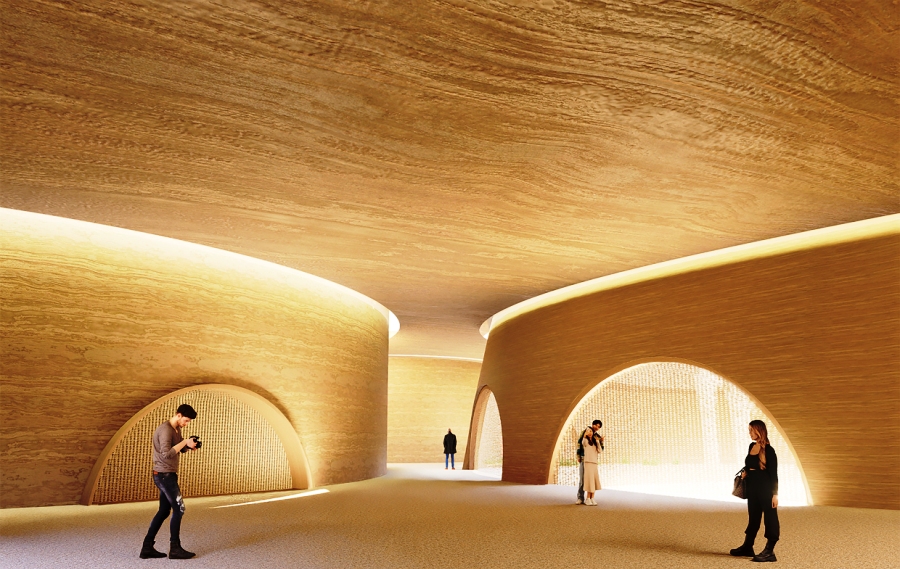
A Glimpse of Interior
What is the total area of the project, estimated cost and design-to-finish time period of the project?
The Xinjiang Hami Pterosaur Museum project has a total construction area of 8,000 sq m, with a total investment of RMB 119 million.
The design period runs from November 2023 to April 2025, and the construction period is scheduled from May 2025 to June 2026.
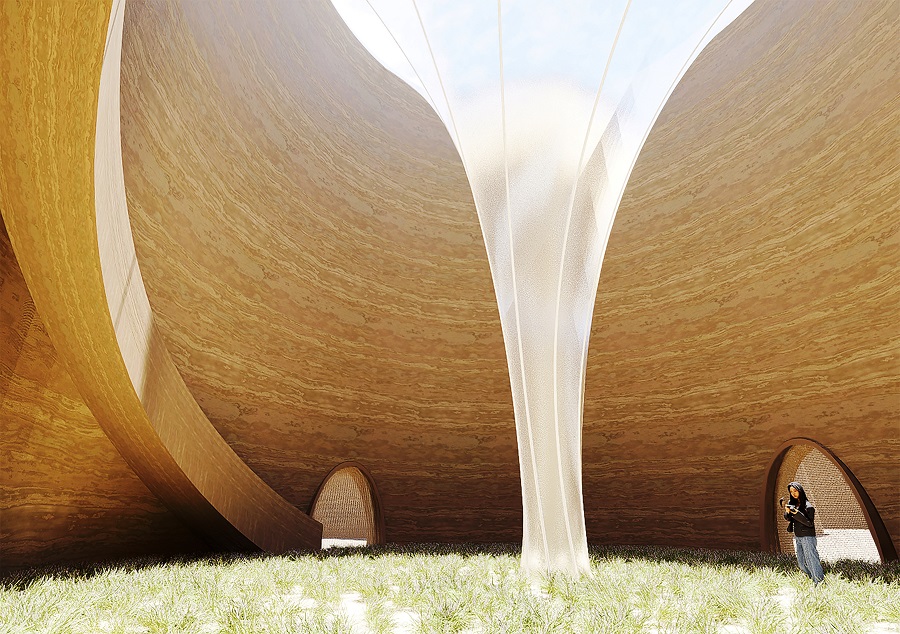
Beyond Imagination
“Sponge Planet”: An AI-Driven New Paradigm for Ecological Civilization by Turenscape will significantly shift the field of landscape architecture towards a better future to mitigate Earth Crisis. Elucidate your perspective
“Sponge Planet” is a vision wherein cities and landscapes work with nature, not against it. Empowered by AI, this approach manages water wisely, restores ecological systems, and redefines urban living. It’s a practical path towards an ecological civilization in the age of climate crisis.
Today, AI can spell check and proof read to catch simple mistakes. In the future, AI will be able to understand urban planning graphs and documents and empower policy makers with expert suggestions that go beyond economic development and gray infrastructure flood mitigation.
Very often bad planning decisions are made not due to a lack of will, but to a lack of way. Experts are rare and expensive. However AI can be a force multiplier for environmental advocates and experts.

A View into Learning Zero-beyond
China has been experiencing catastrophic flooding disasters year after years. Human Greed Crisis / Climatic Destruction have exposed the major “Urban Planning Flaw” as cities after cities are going under water mainly due to ineffective “Drainage and Sewage Systems” and Dams releasing excessive water volume during heavy rains. Elucidate this “Global Urban Planning Flaw” as to how it can be effectively rectified to safeguard our cities from being flooded.
I think the problem is a mix of greed and hubris.
We think that we can defeat nature, that we can use big expensive projects to plan our way out of big problems – problems that were created by big expensive projects in the first place.
Building material suppliers, construction teams, contractors, engineers all make big money off of big project, so they push everything along.
Greed is human nature and cannot be changed. Hubris can be changed.
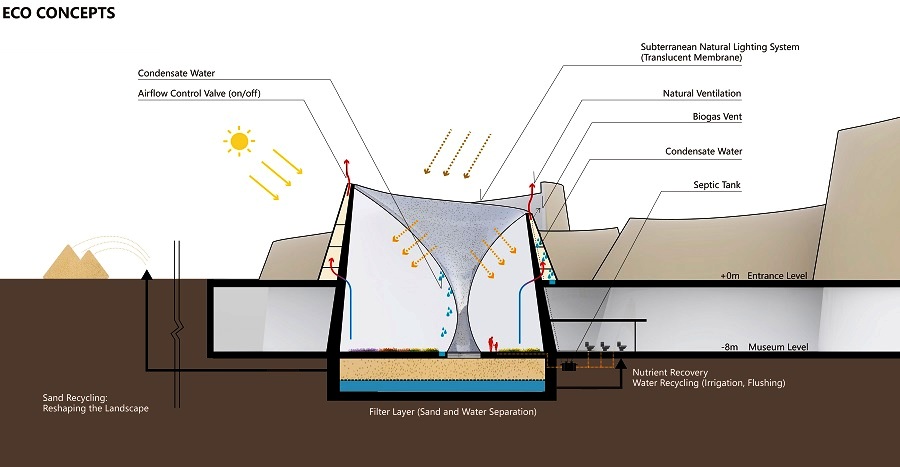
Eco Diagram
The Dunning-Kruger effect – when a person knows a little bit about the subject, but not too much, they are extremely confident, aka hubris. However as they gain more knowledge, they become more humble.
Here I believe that education is the key. The real experts are reverent toward nature, because they know the facts, they know that nature is a system of complex systems and we know so little.
I am optimistic about the future, we are somewhere around the peak of “mount stupid” so everything can only get better right?
Now to the flooding problem, it is not just the heavy rain—it is cities built with hard surfaces, poor drainage, and over-reliance on dams, human ingenuity. We must shift to nature-based solutions like sponge cities: green spaces, wetlands, and permeable surfaces that absorb and release water.
Flood-resilient cities does not mean eliminating floods, but living with floods.
Biological Engineering Grandeur
Which significant aspects of the global platform ‘zerobeyond – the new frontier!’ did you like the most, and why?
As an independent platform, you are allowed to speak your mind and anyone in the world can hear your voice. This was not possible in the past. More and more people are flocking to voices that dare to speak the truth. Stay true, but stay humble.
Unparalleled Vision
How would you differentiate Hongjin Yu as the CEO and a Doctoral Candidate – High Responsibility Vs Student’s Curiosity?
Many people think that there is a conflict between the self and the collective, and many will tout the sanctity of the individual.
My personal belief is that responsibility should always take priority over anything personal. This is not because I am self-sacrificing.
Monumental
I also want personal fulfillment, but you cannot possibly be fulfilled if you know that you were needed and did not show up.
There is a large amount of research that shows that the people that are truly happy are the ones that put others’ happiness before their own.
Right now the Company and the people that work here need stability. They need to know that things will not change drastically overnight. Once there is trust, then we can start moving in new directions (smiles).
Image Courtesy: Turenscape