“Good infrastructure is the backbone of a strong economy!” – China is the sole nation that has not only understood this old adage, but also has been building a strong infrastructure across the world. The 8,000 years ancient civilization’s rise in modern era has made China a formidable force. From Latin America and Africa to the Middle East, Europe, Asia and Oceania – China has been breaking new ground to strengthen nations through massive infrastructure projects.
Chinese infrastructure continues to break records on the global stage. Dr. Kongjian Yu’s ‘Embracing Flood: Xinjiang River Ecological Corridor’ is one such visionary project – that was adjudged as the “Landscape of the Year 2025” and Turenscape was awarded at the World Architecture Festival 2025 at Miami, USA.
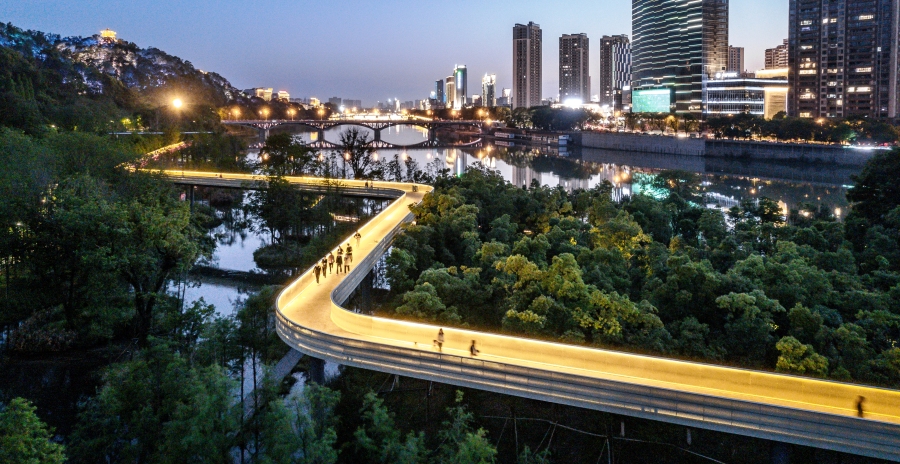
Breathtaking Evening View of Xinjiang River Ecological Corridor
From a 20-Year Flood Disaster Zone to WAF 2025’s Landscape of the Year — This is how China flipped the Script
To transform a flood-hit region spread across 102 hectares into an ecological corridor is not only a bold visionary step, but also depicts China’s strength into achieving greatness while overcoming humongous natural challenges. Dr. Yu’s visionary acumen has transformed the Xinjiang River corridor into a vibrant ecological and recreational space.
While restoring native habitats and offering year-round public access – the project has enhanced flood resilience by utilizing “Sponge City Principles”. Dr. Yu’s visionary creativity embraced water as a dynamic force by integrating it into the landscape to not only keep the biodiversity growing without human intervention, but also has opened doors for fellow peers for “Urban Resilience”. The ecological corridor not only connects humans with nature, but also protects the city from climatic threats. It has become one good scalable model for flood-prone cities worldwide.
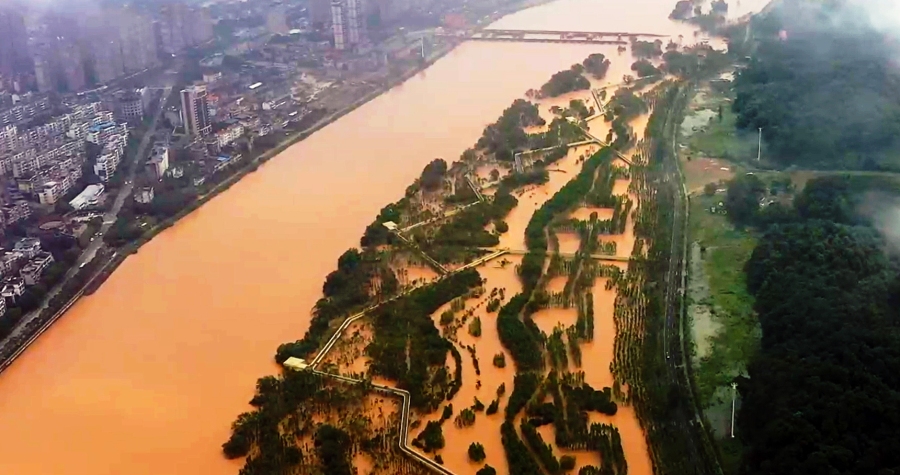
Overcoming Flooding with Creativity
FROM CRISIS TO CLARITY: WHAT THE RIVER DEMANDED — AND WHAT THE CITY HAD TO SOLVE
Degraded by invasive species and informal agriculture, the 3-kilometer-long floodplain was frequently inundated by seasonal floods, thereby making it largely inaccessible. With catastrophic flooding every 20 years, the Municipal Government sought a solution that would:
- Improve flood management and water quality
- Restore native habitats and support biodiversity
- Create year-round recreational spaces
- Offer a cost-effective and sustainable model for urban resilience
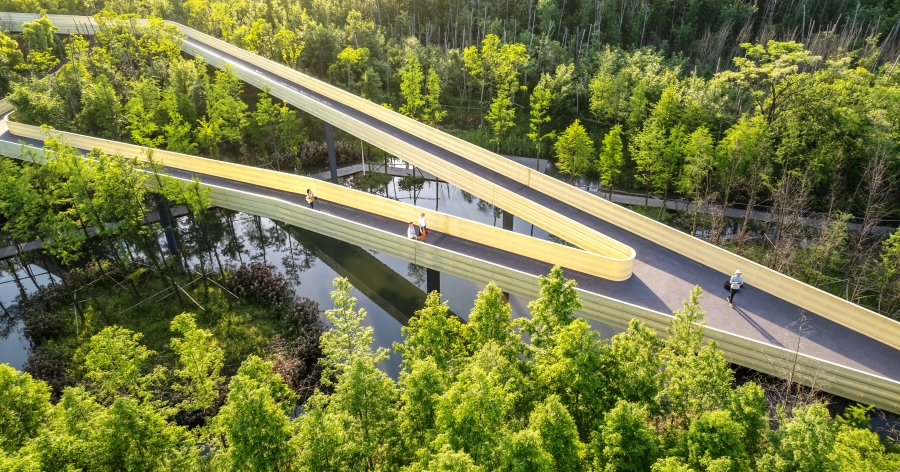
In Nature, With Nature
DR. KONGJIAN YU’S FINAL TRIUMPH SHOWS HOW ONE PHILOSOPHY RESHAPED LANDSCAPES ACROSS CONTINENTS
(i). Turning Floodwaters into Ecological Infrastructure
- The project employs ponding and islanding techniques to restore ecology and enhance flood resilience;
- Creating porous landscapes that retain water, sustain site moisture and form bioswales to filter stormwater from nearby mountain valleys, ponding was used in degraded areas;
- Islanding reshaped low-lying zones into diverse wetland habitats, enriching ecotones and supporting wildlife;
Enhancing biodiversity, while minimizing environmental disruption – these strategies manage floods naturally. Regenerating the landscape and creating an ever-changing visitor experience, seasonal monsoons nourish the wetlands.
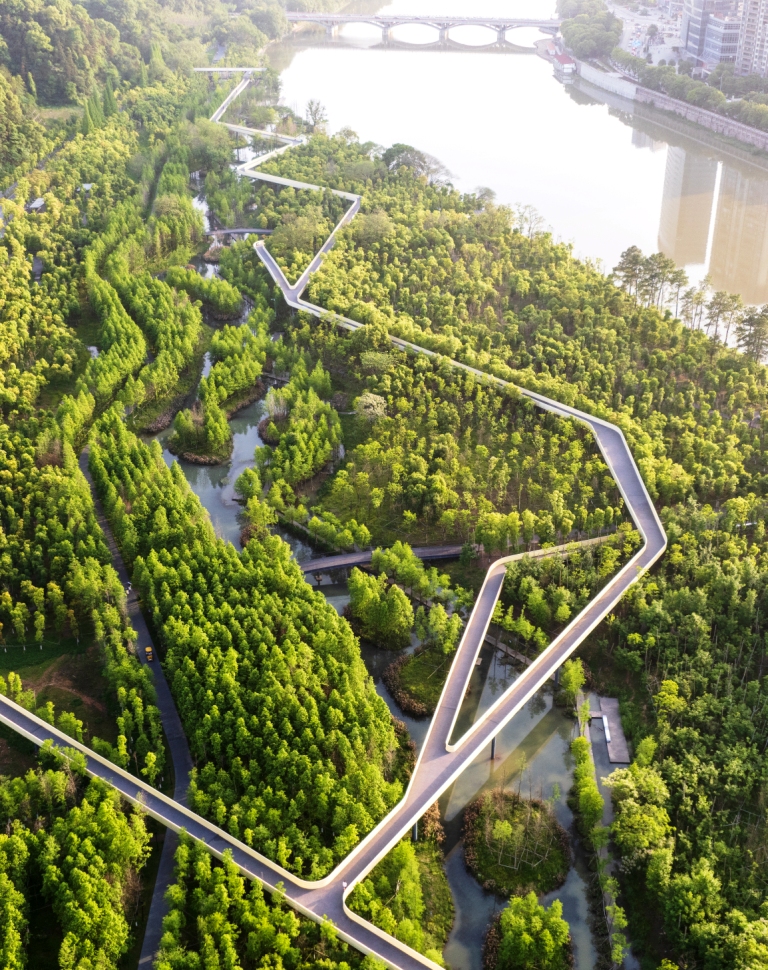
Bird’s-Eye View
(ii). Public Space that Floods — and Still Works
Flood-adaptive structures allow visitors to safely engage with the dynamic waterscape:
- A dual pedestrian system ensures year-round accessibility;
- An elevated skywalk stays dry even during a 50-year flood, offering panoramic views;
- Below, three adaptive boardwalk layers respond to fluctuating water levels, with the lowest submerging during monsoon season;
- Waterfront platforms and observation decks seamlessly integrate recreation with ecological education.
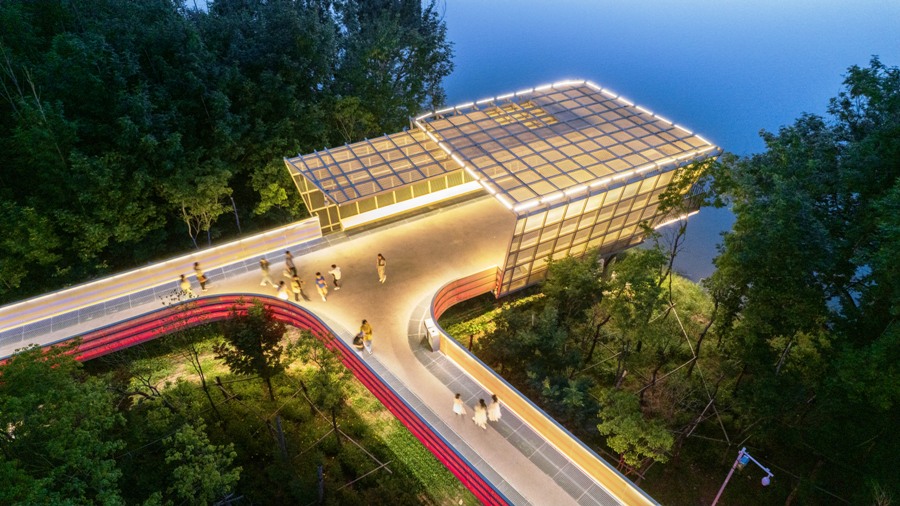
Scintillating Evening View
LOW-COST MATERIALS, HIGH-PERFORMANCE LANDSCAPES
The Park preserves and integrates existing farmland into its design, maintaining a connection to its agricultural past. Productive crops such as sunflowers and canola are grown in rotation, reinforcing the site’s memory and ecological value. To ensure low-cost, durable and flood-resilient construction, the design utilizes local materials and prefabricated components: Modular concrete walkways on pole structures withstand flooding and require minimal maintenance; Natural materials blend seamlessly with the environment, while ensuring longevity and resilience.
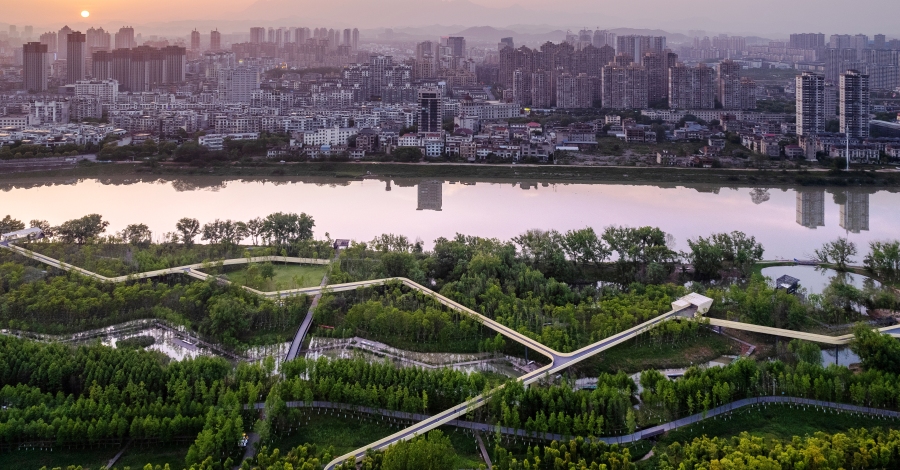
Visionary Design Creation
EMBRACING FLOODS: A BLUEPRINT FOR RESILIENT CITIES
The ‘Xinjiang River Ecological Corridor’ is a pioneering nature-based solution that balances flood protection, ecology and recreation. By embracing seasonal flooding as a design asset, Dr. Yu’s project boosts biodiversity, enhances urban resilience and improves quality of life. Since its completion, it has become a regional landmark, offering a replicable model for sustainable floodplain restoration worldwide.
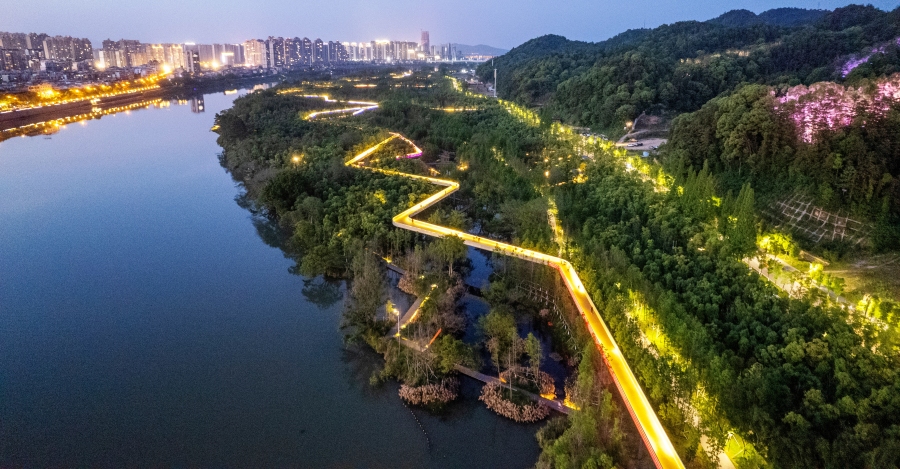
Flourishing Chinese Landscape
HOW ONE MAN’S VISION TURNED FLOODS INTO A GLOBAL MODEL FOR RESILIENT CITIES!
“Think like a King, but act like a Peasant.” – Dr. KONGJIAN YU
- 2025 WAF, Landscape of the Year – ‘Xingjiang River Ecological Corridor’;
- 2025 ASLA Award of Excellence, General Design – ‘Nanchang Fish Tail Park’;
- 2025 ASLA Honor Award, Urban Design – ‘Haikou Meishe River Greenway and Fengxiang Park’;
- 2025 The International Architecture Awards – ‘Sponge Synergy: The Huaiyang Fuxi Cultural Park’;
- 2025 The International Architecture Awards – ‘A Modern Sponge City Inspired by Ancient Wisdom: Sanya Dong’an Wetland Park’;
- 2025 AZ Awards, Best Landscape Architecture – ‘Zhoukou Huaiyang Fuxi Cultural Park’;
- 2025 RAIC International Prize, Turenscape.
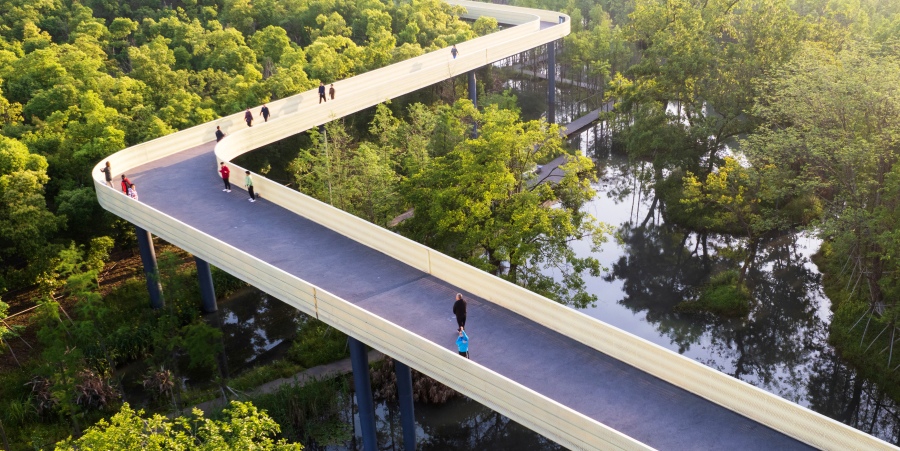
Architecture on Stilts
Legendary Chinese Landscape Architect, Founder of Turenscape, Dr. Kongjian Yu’s legacy will live forever to influence the global landscape urban planning and design. His visionary design creations are a testament to influence his peers, while inspiring the younger generation and coming generations. The legendary figure will always be remembered for opening new vistas with his ingenious ideas and projects’ execution.
The World Architecture Festival 2025 marks Dr. Yu’s visionary triumph by winning the Landscape of the Year 2025 WAF Award for ‘Embracing Flood: Xinjiang River Ecological Corridor’.
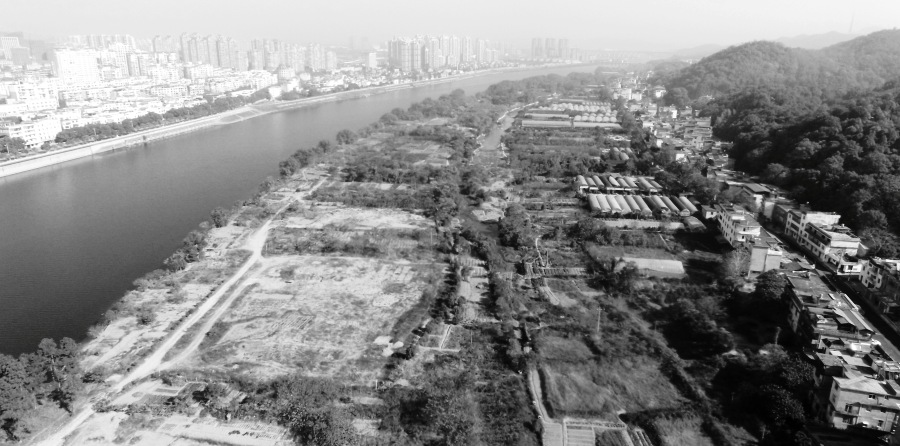
Site Before Transformation
Dr. Yu will always be fondly known as Professor Kongjian Yu by his students and the influenced lot in the field of global landscape planning and design. He is the pioneer of China’s ecological civilization – a designer grounded in the land and devoted to the people. He spent his life racing to save ecosystems and heal the national landscape with bold ideas that many have not dared as yet. Dr. Yu’s deep scholarly legacy and a series of landscapes have not only changed the world, but also have opened unchartered territories for fellow peers across the globe.
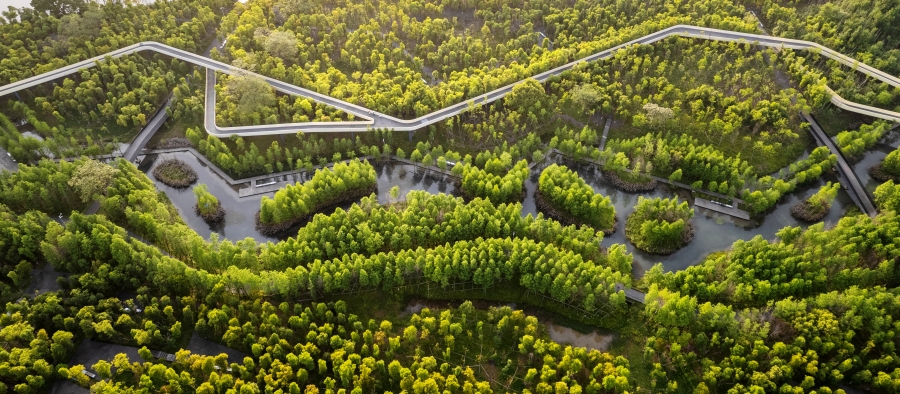
Site After Transformation
Dr. Yu’s sad demise on the 23rd of September 2025 during an ecological field study in Brazil’s Pantanal wetlands in a plane crash has certainly created a void in the field of landscape architecture. Having served the Earth in China, he was a passionate, nature-loving boy who grew up along Baisha Creek, amidst thirty-six irrigation weirs and seven village ponds. His upbringing amidst nature’s embrace profoundly influenced him, instilling the deepest and most steadfast environmental principles.
These formative experiences during his childhood and growing up years shaped Dr. Yu’s advocacy for “Big Feet Aesthetics”, “Negative Planning” and “Sponge City” concepts. During interviews, he often used to recall – how a farming life wrestling with floods, droughts and the land forged his resilience and inspired his reverence for “survival wisdom”. These rural memories sparked his ecological philosophy and fueled his lifelong quest to reconcile humanity with nature.
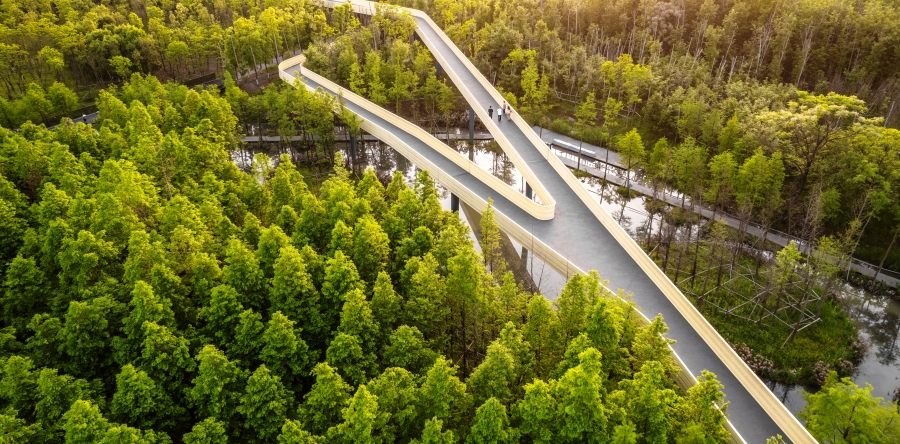
Living in Harmony with Nature
THE SCHOLAR’S RETURN HOME: BUILDING A LEGACY FOR PEOPLE AND NATURE
As a bright young boy, Kongjian Yu joined the Department of Landscape Architecture at Beijing Forestry University in 1980. He graduated with a bachelor and master’s degrees in Agronomy. After completing his Master’s, Yu began teaching at Beijing Forestry University. In the year 1992, Kongjian Yu joined the Harvard Graduate School of Design as a Ph. D Candidate. His pioneering research began with the ESP – Ecological Security Pattern.
During his Doctoral pursuit, Kongjian Yu worked as a designer at the renowned SWA Group, participating in major international projects. In 1997, Dr. Kongjian Yu returned to his homeland and joined the Peking University. His passion and dedication to educate the younger generation was truly exemplary. He dedicated himself to research and launched a career in service of national ecological security.
Dr. Kongjia Yu established the Center for Landscape Planning and Design at Peking University, and later the College of Architecture and Landscape Architecture and related institutes. He not only promoted landscape architecture as an independent first-level discipline to establish the journal Landscape Architecture Frontiers, but also systematically built an ecological design education system oriented to China’s territorial challenges to improve the lives of fellow citizens.
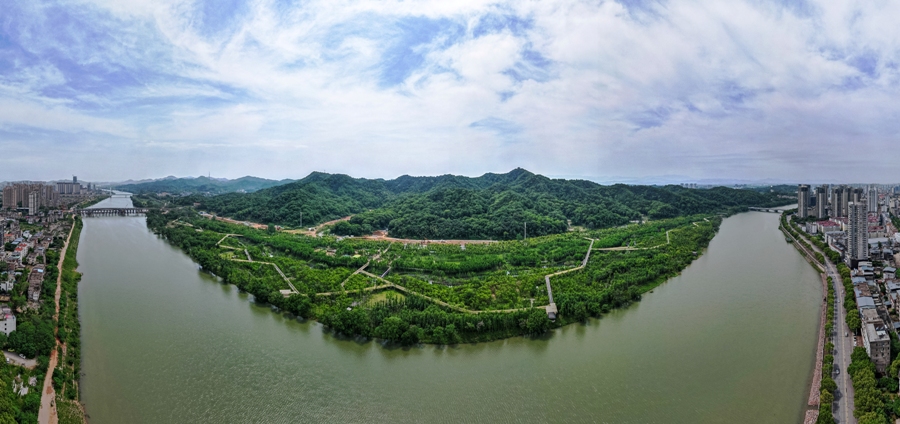
Panoramic View
THE GROUNDBREAKING THEORIES SHAPING CHINA’S ECOLOGICAL REVOLUTION
In the year 1995, Dr. Kongjian Yu’s proposal of the ESP – Ecological Security Pattern theory became the most foundational and groundbreaking academic contribution. Offering systematic support for drawing “Ecological Red Lines” and for integrating protection of mountains–rivers–forests–farmlands–lakes–grasslands–deserts, ESP provides scientific methods to identify and protect the key structural patterns of ecosystems.
ESP has not only supplied the base-map logic for China’s territorial spatial planning, but also has become an important reference for ecological governance worldwide. With more than 500 derivative studies indexed in international SCI databases, ESP has been cited over 30,000 times.
Building upon ESP, Dr. Yu advanced a negative planning approach: a methodology prioritizing ecological protection, by first controlling non-buildable areas to guide urban spatial development and thereby forming a green network that safeguards national land security, returning planning from a purely technical tool to a practice for the public good.
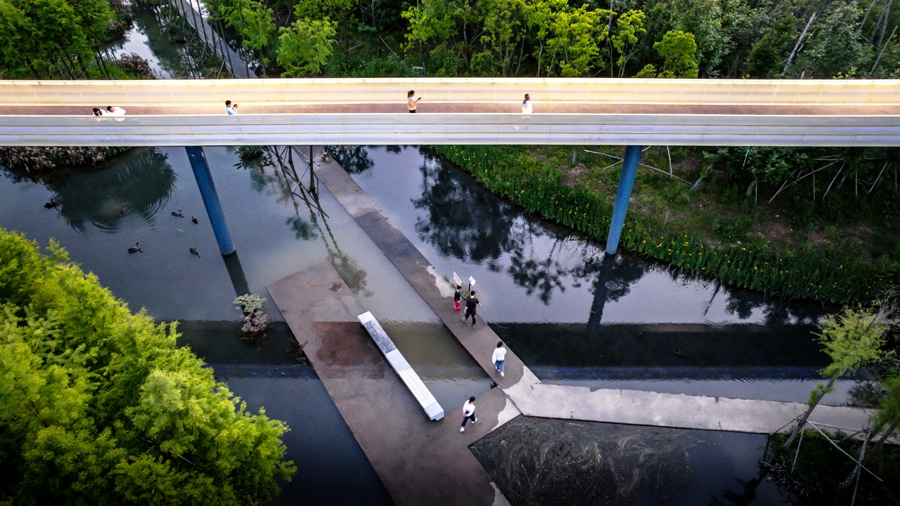
Aerial View
ENGINEERING ANCIENT WISDOM: INNOVATIVE METHODS THAT RESTORE NATURE AT SCALE
Dr. Yu went onto achieving far-reaching innovations in engineering methods. He distilled traditional practices from China’s agrarian civilization – such as terraces, pond-dikes, beitang ponds and raised-mound “islands” – through scientific modeling, performance assessment and modular integration, by establishing an “engineering pathway for traditional ecological wisdom”.
These modules retain the holistic properties of traditional systems, while gaining efficiency and standardization of industrial systems. They have become core units in China’s large-scale ecological restoration, widely applied to Sponge City construction, water remediation, degraded wetland restoration and saline-alkali land improvement.
Through this NbS – Nature-based Solutions system, Dr. Yu addressed the dual challenges of limited land resources and low natural recovery efficiency, offering a replicable Chinese model for global climate adaptation and ecological resilience.
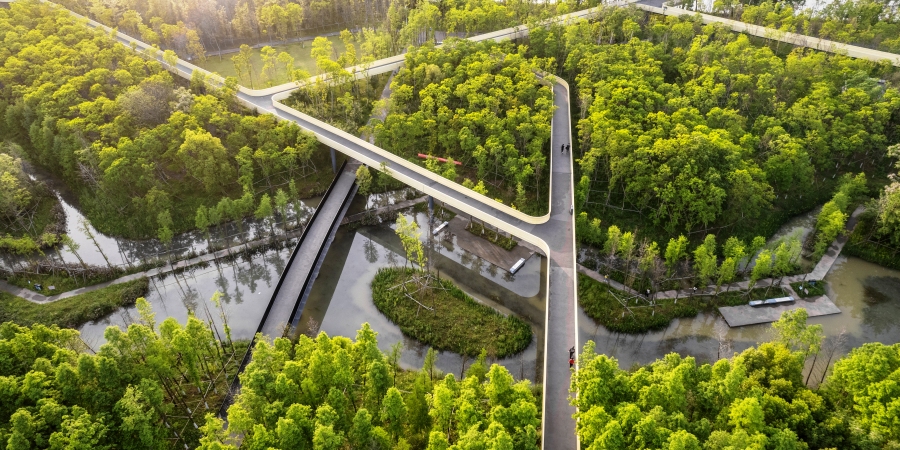
Engineering Pathway for Traditional Ecological Wisdom
By 2025, Dr. Kongjian Yu and his team had led over 1,000 ecological engineering projects across 200+ cities in China and in more than ten countries including the United States, Russia, Mexico and Thailand. Some of the most prominent works include ‘Jinhua Yanweizhou Park’, ‘Houtan Park’ (Shanghai Expo legacy), ‘Haikou Meishe River Greenway and Fengxiang Park’, ‘Sanya Mangrove and Dong’an Wetland Parks’, ‘Nanchang Fish Tail Park’, ‘Red Ribbon Park’ and ‘Tianjin Qiaoyuan Wetland Park’.
These projects achieved notable results in ecological restoration, water purification and habitat reconstruction, while presenting a compelling design aesthetic. They have been highly acclaimed at home and abroad. These projects have also become important references for urban green transitions and the building of an ecological civilization.
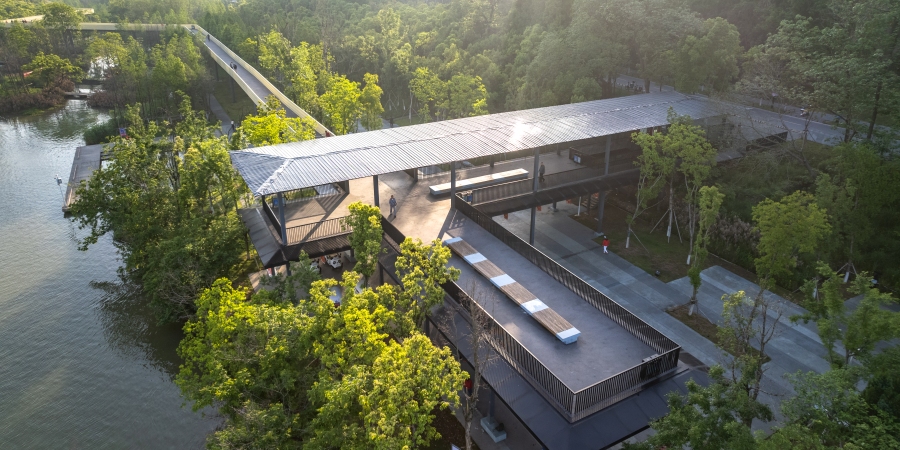
Observation Deck
SHAPING CHINA’S ECOLOGICAL FUTURE: FROM POLICY TO PRACTICE
Dr. Kongjian Yu led the preparation of China’s first national ESP master plan, contributed to drafting policies and regulations for Ecological Red Lines and integrated “mountains-rivers-forests-farmlands-lakes-grasslands-deserts” restoration (“Shanshui” projects) and helped embed the ESP concept into multiple state strategies.
Dr. Yu reviewed to edit training texts organized by the Party’s Organization Department and the Ministry of Housing and Urban–Rural Development and delivered more than 300 policy trainings and lectures. He became one of the key academic pillars of the top-level design behind “Beautiful China” and “Ecological Civilization”.
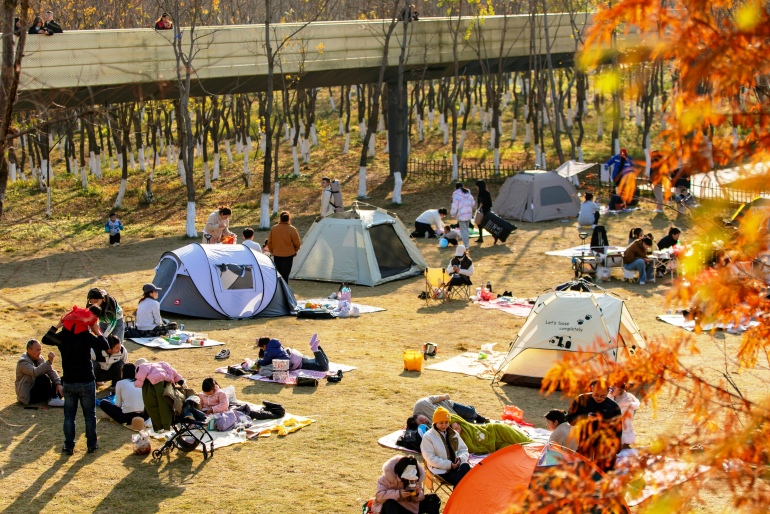
In Nature’s Lap
GLOBAL IMPACT: EXPORTING CHINA’S ECOLOGICAL WISDOM TO THE WORLD
Dr. Yu’s ideas and engineering practices have drawn wide international attention. He was invited three times to present the U.S. National Academies of Sciences, Engineering and Arts & Sciences. He has delivered hundreds of keynotes at IFLA, WAF, ASLA, the World Economic Forum, UNESCO and other global venues.
Dr. Kongjian Yu had also served as the Director of the IUCN Global NbS Innovation Center and as the Chair of IFLA’s Committee on Water Security and Management, holding significant voice in global ecological design. Projects under his leadership were selected four times among IUCN’s Top Ten Global Ecological Restoration Practices, representing Chinese design on the world stage.
Hailed as the “Chinese model” for climate-resilient design worldwide, Dr. Kongjian Yu’s theories and methods have been featured by Scientific American, Nature Water, MIT Technology Review and other leading outlets.
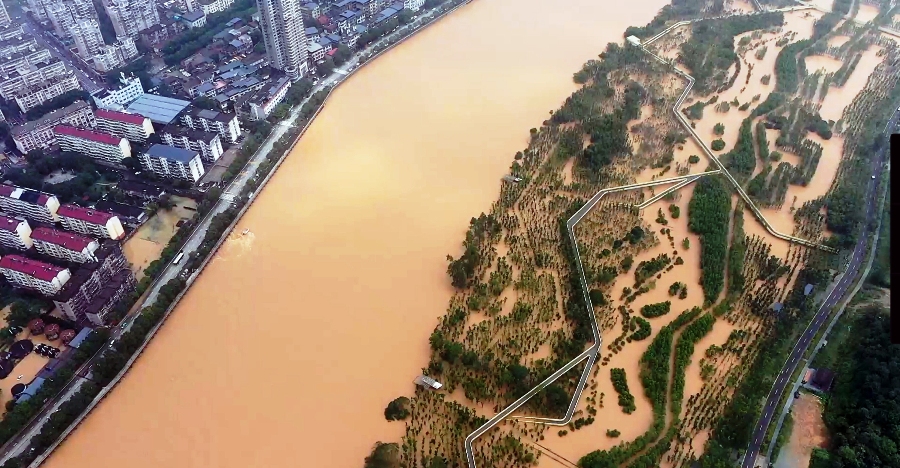
Aerial View during Flooding
AN UNFINISHED JOURNEY: PRESERVING DR. KONGJIAN YU’S GLOBAL ECOLOGICAL VISION
In the days before the accident, Dr. Kongjian Yu was still traversing the Pantanal – “the lungs of the Earth” – sounding the alarm: “As the last Edens retreat, where will humankind find hope for survival?”
Dr. Yu often stated, “Think like a King; but act like peasants.” This was not only a designer’s ethic, but also a scholar’s conviction. The theoretical system, practical paradigm and educational institutions he built have become vital supports for ecological civilization in China and beyond.
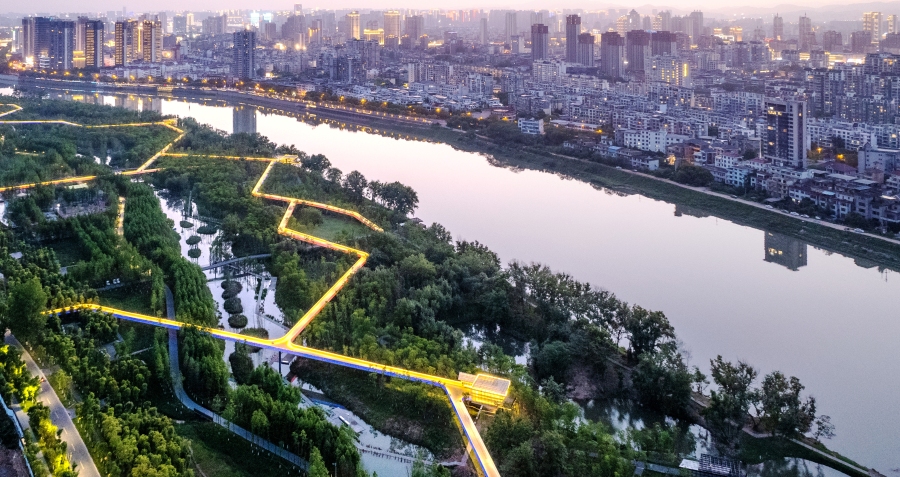
Landscape View of the City
It is indeed Planet Earth’s loss as Dr. Kongjian Yu’s life came to rest between earth and sky. However, his ideas and spirit will continue in the work of those who follow – guiding landscape designers, city-builders and ecological restorers around the world.
What Dr. Yu called “the deep form” is more than a design language; it is a return of the heart – to nature, to the people and to the justice and warmth of the land.
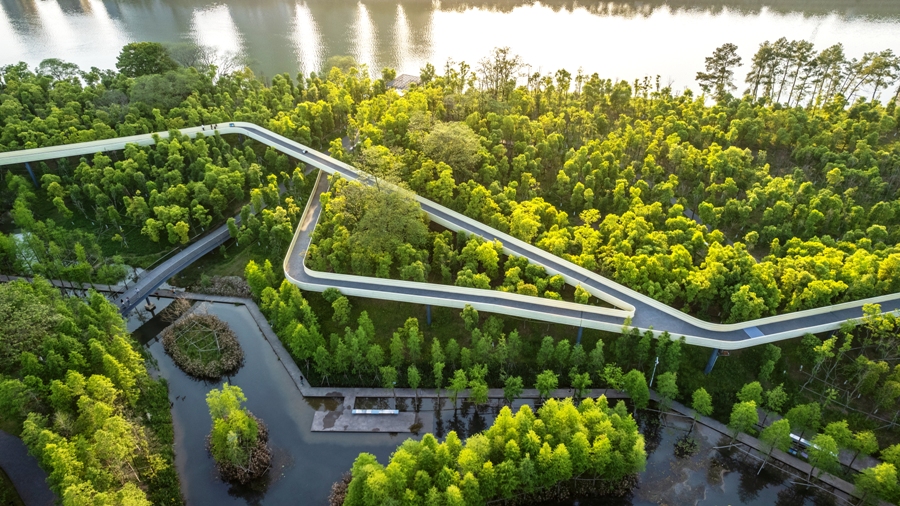
The Deep Form
PLEASE NOTE: For more on the Xinjiang River Ecological Corridor, check out this detailed project article.
Image Courtesy: Turenscape