
CASE STUDY: The Deconstruction of a Corporate Smoke Screen
SERIES:The GEN Z Guide-to-Mentor
HOST: Johnny D, Founder of ‘zerobeyond – the new frontier!’
STATUS: [ARTICLE DELETED by the AUTHOR / My PROFILE BLOCKED on LinkedIn]
THE OBJECTIVE:
To show the next generation of architects, planners, and engineers exactly how elite, corporate-funded academia uses hyper-complex jargon (Eco Adaptive Intelligence, Digital Twins, AI Governance) to greenwash the structural engineering failures of modern “Smart ‘Flooded’ Cities”.
THE SUBJECT:
An academic article titled “From the ‘Smart City’ to the ‘Self-Adaptive City’: Redefining Urban Intelligence in an Era of Climate Uncertainty” by Reza Mirzaei (August 19, 2026) on LinkedIn.
THE REAL-TIME RESULT:
When the unvarnished ground realities and scientific explanations were elucidated for a healthy debate with the author — interestingly, no algorithm could really absorb a drop of water, no IoT sensor could vaporize a flooded street, and cities need physical pipes, drainage, and unpaved earth rather than software subscriptions — the corporate narrative collapsed. The author deleted the article from the public domain and blocked my profile on LinkedIn.
THE BIG CAUTION FOR GEN ZS and GEN ALPHA:
The elite could not defend their software models, when the physical truth were elucidated scientifically based on ground realities. Do not get brainwashed by their dashboards.
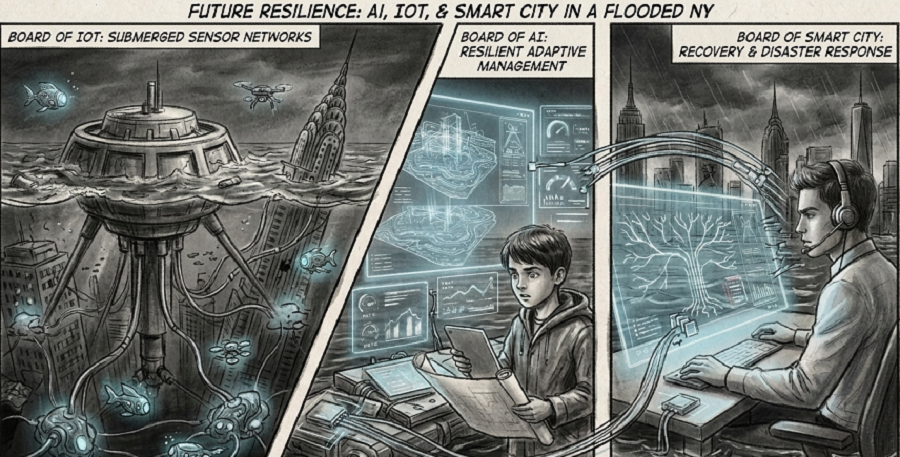
HERE COMES THE ERA OF DASHBOARD PUPPETEERS
How Technocratic Narratives are Rebranding Urban Failure
Over the past two decades, the global field of urban planning has undergone a profound ideological mutation. A discipline once rooted in the brutal, material realities of civil engineering, hydrology, and structural architecture has been systematically subsumed by a cloud of digital abstractions. Initially, this took the form of the “Smart City” — a paradigm that promised absolute municipal efficiency through an omniscient network of sensors, cameras and data streams.
Yet, as the intensification of “Earth Crisis”, popularly coined by me as “Human Greed Catastrophes”, subjects our cities to unprecedented torrential downpours, severe heat waves, and erratic environmental crises, these highly digitized urban landscapes are failing miserably. Smart Cities are drowning left, right and centre to expose the urban planners’ vision, policymakers’ failure and corporate greed-to-exploit to make trillions of dollars’ profit annually amidst all the destruction.
Instead of treating these catastrophic failures as an urgent mandate to strengthen the age-old physical infrastructure, corporate-funded academia has executed a “super brilliant” strategic pivot. Emerging frameworks are rebranding the failed Smart City into the “Self Adaptive City”, introducing jargon like “Eco Adaptive Intelligence” and “Urban Digital Twins”. What is presented as a progressive leap in urban resilience is, in reality, a dangerous linguistic smoke screen.
By replacing physical engineering with continuous software feedback loops, this latest paradigm shifts accountability from structural efficacy to endless data optimization.
The ultimate casualty of this intellectual shift is the GEN Zs and the “Next Generation” of urban planners, architects, and engineers. Universities are graduating a generation of professionals, who are functionally illiterate in basic civil engineering but completely fluent in corporate tech jargon. They are being trained, “Programmed” would be much better synonym, to manage crises from digital dashboards rather than solve them in the real physical world.
This is the emergence of the ERA OF DASHBOARD PUPPETEERS – How Technocratic Narratives are Rebranding Urban Failure: The truly “Elite Class of Technocrats”, who would sit in dry, air-conditioned command centers, watch beautiful digital twin simulate a disaster in real-time, while the actual working-class citizens outside are trapped on the roofs of their cars and houses.
1. THE DATA AND PHYSICS FALLACY
The foundation of the “Self-Adaptive City” narrative rests on a fundamental scientific delusion: the belief that natural disasters are primarily problems of the information rather than physics. In his critique of the traditional ‘Smart City’, Reza Mirzaei notes that models trained on historical data fail, when confronted with unprecedented “Black Swan” climate events. His proposed solution, however, exposes the core trick of the academic-corporate pipeline.
He argues that the city must develop a “capacity to learn, recalibrate, and respond” through a continuous cycle: {Data} > {Analysis} > {Decision} > {Implementation} > {Feedback} > {Learning} > {Decision Adjustment}
This represents the Myth of the Continuous Learning Cycle. Water is a physical mass governed by fluid dynamics, not a digital variable that can be reasoned with via algorithmic feedback. If a concrete street is subjected to five hours of torrential rain, adding a “Learning” phase to a municipal dashboard does not expand the physical diameter of an underground sewer pipe by a single centimeter. The narrative deliberately tricks promising young and promising urban planners into believing that understanding a crisis conceptually is equivalent to mitigating it physically.
This delusion is bein weaponized through the Myth of the Digital Twin, celebrated by academics as the “Experimental Brain” of the city. Planners are taught that creating a hyper-detailed virtual replica of an urban center allows them to simulate floodplains and test policies dynamically before deployment.
In reality, a digital twin is an incredibly expensive, corporate-licensed video game.
It tells the user what basic physics already dictates: concrete is impermeable, asphalt creates runoff, and water flows downhill. A pixelated simulation of a flood does absolutely nothing to absorb actual rainwater.
By treating the virtual model as the ultimate achievement, universities condition young architects to prioritize software manipulation over physical earthwork, completely ignoring the unglamorous necessity of tearing up concrete, breaking ground, and building massive gravity-fed drainage channels.
Compounding this fallacy are the concepts of “Eco Adaptive Intelligence” and IoT sensor networks. This framework insists that cities must move away from “fixed engineering solutions” to embrace flexible, cognitive software networks.
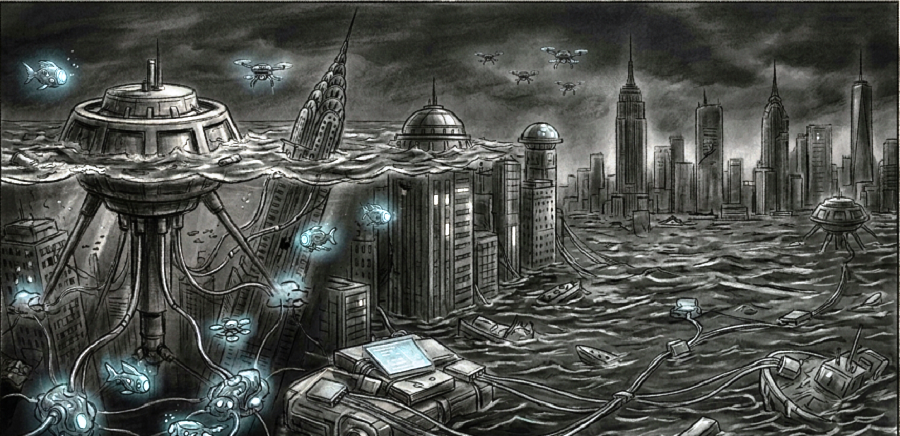
But, a city built entirely of concrete that lacks physical exit paths for excess water will inevitably flood, regardless of how intelligent its digital infrastructure claims to be. When a metropolis is actively drowning, an IoT sensor network flashing red on a screen provides nothing more than a high-definition autopsy of a predictable disaster.
It provides situational awareness without structural utility, meticulously documenting casualties in real-time while offering no physical escape path for surging floodwaters and overflowing drainage potholes.
To be continued in Part II…
NOTE: Illustrations have been used for representation purpose only.